Master Books · Grade 12
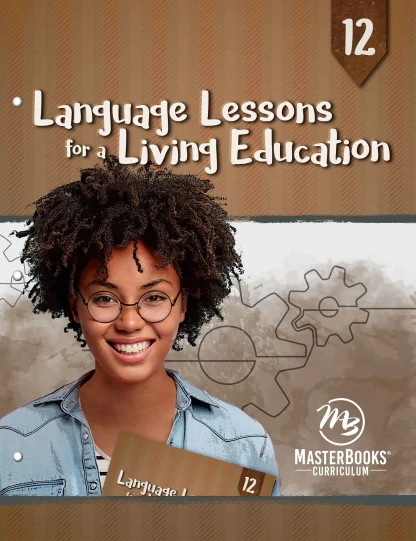
Language Lessons for a Living Education 12
Part of Language Lessons for a Living Education · Level 12. See every level.
- Free shipping on orders $50+ anywhere in the US, including Alaska and Hawaii.
- Free returns within 30 days, like new. Return policy
- Help choosing. Ask us what to buy.
Description
Place the capstone on your Language Lessons journey with Language Lessons for a Living Education Level 12, a Christian high school English curriculum designed for 12th-grade students. This comprehensive language arts program is rooted in a biblical worldview, specifically the Book of Job.
High School Language Arts with a Biblical Worldview
This course is based on the belief that communication is important to God. But because communicating effectively does not always come naturally, teens need instruction and practice to refine their communication for clarity, precision, and godliness. Language Lessons 12 fills that gap, giving teens the communication confidence they need for whatever lies after graduation.
What This 12th Grade Homeschool English Course Covers
Composition Formats: Research papers (including a review of three citation styles covered in previous levels: Chicago from Level 9, MLA from Level 10, and APA from Level 11); essays, including timed essays, the personal statement, and thematic essays; summaries; short stories; work-related writing such as business letters and emails, cover letters, proposals, memos, meeting minutes, and résumés; and daily communication such as text messages and social media posts.
Composition Skills: Word choice; concise writing; sentence structure (including fragments, parallelism, and modifier errors); thesis development; essay structure, including outlining and drafting; summarizing; revising writing based on higher- and lower-order concerns; editing and proofreading for grammar, mechanics, consistent verb tense, etc.
Integrity: Plagiarism and copyright awareness, using AI in writing.
Speaking: Reading aloud; planning and delivering an oral presentation (on a political topic); speech inflection, including pace, tone, pitch, and volume; nonverbal communication such as body language, facial expressions, eye contact, gestures, posture, and proximity; job interview skills.
Literary Analysis: Through a study of the Book of Job, students learn to identify and evaluate literary devices such as figurative language, imagery, and point of view, and apply this understanding in analytical writing.
Vocabulary: Word precision is a primary focus of the course, with first-semester vocabulary drawn from Dr. Morris’ commentary and second-semester vocabulary drawn from the KJV text of Job itself. Students learn connotation and denotation.
Other Topics: Art analysis, hymn lyrics, poetry, and scripture memorization.
Curriculum Features
The open-and-go structure of Language Lessons makes it ideal for independent learners and supports parents who are serving as coaches or facilitators for their teens.
All-in-one — student text and teacher resources in a single volume.
Suggested daily schedule for 36 weeks.
Assessments with grading tips, rubrics, and answer keys.
Teaching resources and extension activities.
Reading lists.
Schedule
The flexible daily schedule organizes the course into approximately 50-minute daily lessons, five days each week for a full school year (36 weeks in all). The weekly routine follows a repeating pattern:
Day 1 Special feature (such as poetry, art analysis, hymn lyrics), vocabulary, scripture memorization
Day 2 Writing mechanics and word choice
Day 3 Communication
Day 4 Worldview and literary analysis
Day 5 Review
High School Credit
Language Lessons for a Living Education 12, when completed as suggested with The Remarkable Record of Job and additional readers you select, counts as one credit of high school English. Table of Contents
Course Description
Suggested Daily Schedule
Lesson 1
    Special Feature; Vocabulary
    Writing Mechanics & Word Choice, Eight Parts of Speech
    Communication Introduction, Abstract Diction, Acronyms
    The Most Fascinating Book in the Bible
    Review
Lesson 2
    Picture Study: Angel Sculpture; Vocabulary
    Phrases and Clauses, Parallelism
    Job Applications; Acrostic, Afterword, and Antonyms
    Who Wrote Job’s Record?
    Review
Lesson 3
    Hymn Study: God Moves in a Mysterious Way; Vocabulary
    Verbs: Action, State of Being, Linking, and Helping, Helping Verbs
    Summarization Skills; Attachments, Back Matter and Bibliography
    Reflections of Primeval History
    Review
Lesson 4
    Scripture Study: Verses About Suffering; Vocabulary
    Common Adjective Suffixes (Part 1); Ask vs. Request
    Timed Essays; Business Letter, Cliché, and Content Writing
    End of the Flood
    Review
Lesson 5
    Excerpt Study: Is There a Gospel in the Stars?; Vocabulary
    Common Adjective Suffixes (Part 2); Who vs. Whom
    Timed Essay Practice 1: Poem Analysis; Copyediting, Copyright, and Cover Letter
    Modern Scientific Insights in Job
    Review
Lesson 6
    Picture Study: Starry Night Over the Rhone; Vocabulary
    Common Adverb Suffixes; Include vs. Contain
    Body Language (Part 1): Facial Expression and Eye Contact; Deadline, Didactic, and Draft
    The Stars of the Heavens
    Review
Lesson 7
    Poem Study: Lord, Our Lord, Your Glorious Name; Vocabulary
    Adjectives and Adverbs: Common Mistakes; Gone vs. Went
    Body Language (Part 2): Gestures, Posture, and Proximity; Edit, Editor, and Editorial
    A Godly Man and the Scientific Method
    Review
Lesson 8
    Scripture Study: Acts 7:2–8; Vocabulary
    Homophones; Sound vs. Noise
    Timed Essay Practice 2: Body Language; Epilogue, Essay, and Executive Summary
    God’s Scientific Hypothesis
    Review
Lesson 9
    Excerpt Study: Aunt Jane’s Hero; Vocabulary
    First Quarter Writing Mechanics & Word Choice Look Back
    First Quarter Communication Look Back
    Miserable Comforters
    Review
Lesson 10
    Excerpt Study: Gifted Mind; Vocabulary
    Context; Then vs. Than
    Speech Inflection (Part 1); Pace, Tone, Pitch, and Volume
    Elihu, the Super-Spiritual
    Review
Lesson 11
    Picture Study: Garden of Eden; Vocabulary
    Using Context Clues; Sympathy vs. Empathy
    Speech Inflection (Part 2); Reading Aloud; Formatting, Freewriting, and Front Matter
    The Healing Message of Creation
    Review
Lesson 12
    Hymn Study: A Mighty Fortress Is Our God; Vocabulary
    Nuance; Systemic vs. Systematic
    College Application Essay/Personal Statement; Ghostwriter, Graphic Organizers, and Hardcover
    The Real Purpose of the Book of Job
    Review
Lesson 13
    Scripture Study: New Testament Verses About Creation; Vocabulary
    Connotation and Denotation; Amount vs. Number
    College Application Essay/Personal Statement Outline; How-to and Imprint
    The World That Then Was
    Review
Lesson 14
    Excerpt Study: Biblical Commentaries with Dragons; Vocabulary
    Connotation and Context; Aggressive vs. Enthusiastic
    College Application Essay/Personal Statement: Rough Draft and Final Draft
    Dragons, Dinosaurs, and the Devil
    Review
Lesson 15
    Picture Study: Leviathan; Vocabulary
    Conjunctions; Imply vs. Infer
    Short Stories; Invitation
    Leviathan
    Review
Lesson 16
    Poem Study: God, Be Merciful to Me; Vocabulary
    Concise Writing (Part 1); Wordy vs. Concise
    Short Story Worksheet; Jargon and Job Description
    The End of the Lord
    Review
Lesson 17
    Scripture Study: We Shall See God; Vocabulary
    Concise Writing (Part 2); Precede vs. Proceed
    Short Story Draft; Journal
    Twice as Much
    Review
Lesson 18
    Excerpt Study: Six Days; Vocabulary
    Second Quarter Writing Mechanics & Word Choice Look Back
    Second Quarter Communication Look Back
    Short Essay Assignment on the Life of Job
    Review
Lesson 19
    Excerpt Study: Developing a Heart for God; Vocabulary
    Commas; Whether vs. If
    Résumé Introduction; Lead and Manuscript
    Character Sketch, Foreshadowing, Repetition, and Paradox
    Review
Lesson 20
    Picture Study: Kintsugi (Broken Pottery); Vocabulary
    Idioms; Good vs. Well
    Résumé Assignment; Meeting, Minutes, and Memos
    Imagery, Symbolism, Lament, and Hyperbole
    Review
Lesson 21
    Hymn Study: From the Cross to the Crown; Vocabulary
    Quotation Marks; Impact vs. Effect
    Facial Expressions; First-Person Narrator and Third-Person Narrator
    Rhetorical Question, Parallelism, Simile, and Metaphor
    Review
Lesson 22
    Scripture Study: Psalm 17:8–15; Vocabulary
    Subject-Verb Agreement; Farther vs. Further
    Eye Contact; Palindrome and Performance Review
    Metonymy, Synecdoche, and Personification
    Review
Lesson 23
    Excerpt Study: The Remarkable Journey of Jonah; Vocabulary
    Forming Possessives; Fewer vs. Less
    Gestures; Press Release and Prologue
    Irony
    Review
Lesson 24
    Picture Study: Artist’s Palette; Vocabulary
    Commonly Misspelled Words; Everyday vs. Every day
    Posture; Proposal
    Apostrophe
    Review
Lesson 25
    Poem Study: On the Threshold; Vocabulary
    Consistent Verb Tense; Bring vs. Take
    Proximity; Pseudonym and Public Domain
    Tone and Theme/Thematic Essay Assignment
    Review
Lesson 26
    Scripture Study: Psalm 1; Vocabulary
    Types of Punctuation; Adverse vs. Averse
    Job Interviews; Royalties and Self-Publishing
    Dialogue Tags/Thematic Essay Assignment
    Review
Lesson 27
    Excerpt Study: Creation to Babel; Vocabulary
    Third Quarter Writing Mechanics & Word Choice Look Back
    Third Quarter Communication Look Back
    Thematic Essay Worksheet/Rough and Final Drafts
    Review
Lesson 28
    Excerpt Study: Developing a Heart for God; Vocabulary
    Artificial Intelligence and Writing; Evoke vs. Invoke
    Nonverbal Communication: What You Wear Matters; Slant and Synopsis
    Pleonasm
    Review
Lesson 29
    Picture Study: Molten Metal; Vocabulary
    Misplaced, Dangling, or Squinting Modifiers; Elicit vs. Illicit
    Contextual Communication and Active Listening; Social media posts
    Allusion, Juxtaposition, and Extended Metaphor
    Review
Lesson 30
    Hymn Study: Open My Eyes That I May See; Vocabulary
    Writing Abbreviations; Among vs. Between
    Revising: Higher- and Lower-Order Concerns; To-Do List
    Idioms
    Review
Lesson 31
    Scripture Study: Verses About Pride and Humility; Vocabulary
    Formal vs. Informal Writing; Award vs. Reward
    Political Essay Introduction; Text messaging
    Pleonasm
    Review
Lesson 32
    Excerpt Study: The Remarkable Wisdom of Solomon; Vocabulary
    Concise Writing Practice; Background vs. Backdrop
    Political Essay Work
    Types of Imagery
    Review
Lesson 33
    Picture Study: Storm Over Lake Balaton; Vocabulary
    Handwriting: Why It Matters; Lay vs. Lie
    Political Essay Rough Draft
    Job 38–39
    Review
Lesson 34
    Poem Study: Lord! How I Love Thee!; Vocabulary
    Informal How-To Writing; Accept vs. Except
    Political Essay Final Draft; Oral Presentation Introduction; Writer’s Block and Yarn
    Job 40–42
    Review
Lesson 35
    Scripture Study: The Preeminence of Christ; Vocabulary
    Day Planners, Which Word? First and Second Quarter Review
    Business Letters and Emails; Written Communication Terms Review
    Thematic Essay Writing Assignment
    Review
Lesson 36
    Excerpt Study: The Door of Learning from Made in Heaven; Vocabulary
    Review: All Quarters, Which Word? Third and Fourth Quarter Review
    Self-Evaluation Timed Essay, Written Communication Terms Review
    Thematic Essay Rough Draft and Final Draft
    Review
Assessments & Grading
Teaching Resources
Answer Key
Details
| SKU | 49008 |
|---|---|
| ISBN | 9781683443308 |
| Publisher | Master Books |
| Grade | Grade 12 |
| Subject | English |
| Format | Paperback |