
Curriculum · English
Classical Composition
The ancient progymnasmata in nine graded stages, from retelling a fable to building and defending a thesis.
- Grades 4–12
- More from Memoria Press
Not sure which level? See Memoria Press' placement guide (on their website)
Choose a level
Grades are a guide. Not sure? Ask us what to buy.
Grade and level don’t always match. Choose by what your child is working on now.
- The first stage of the progymnasmata: students retell a fable, restructuring the facts and saying the same idea with different words and sentence structures. Memoria Press starts it in fourth grade; older beginners can take Fable and Narrative in one year.I: Fable · Grades 4–6
- Students keep building invention and tell a story. Memoria Press places it in fifth grade, after Fable.II: Narrative · Grades 5–7
- The Chreia and Maxim exercises, the third stage; Memoria Press places it in sixth grade.III: Chreia & Maxim · Grades 6–8
- Two sets of exercises that work like an argumentative essay: students learn to structure an argument for or against an idea, a chain of events or a story. Memoria Press places it in seventh grade.IV: Refutation & Confirmation · Grades 7–9
- The Common Topic stage, taken after stages I to IV; Memoria Press places it in eighth grade.V: Common Topic · Grades 8–10
- Encomium, Invective and Comparison, taken after stages I to V; Memoria Press places it in ninth grade.VI: Encomium, Invective & Comparison · Grades 9–11
- Characterization, taken after stages I to VI; Memoria Press pairs it with Description in tenth grade.VII: Characterization · Grades 10–12
- Description, the companion stage to Characterization in Memoria Press's tenth grade.VIII: Description · Grades 10–12
- The final stages bring in counterpoint and resolution. Students create arguments and defend them.IX: Thesis & Law · Grades 11–12
Grades 4–6I: Fable
The first stage of the progymnasmata: students retell a fable, restructuring the facts and saying the same idea with different words and sentence structures. Memoria Press starts it in fourth grade; older beginners can take Fable and Narrative in one year.2 sets · $92.65–$96.22
Choose one set
- Set
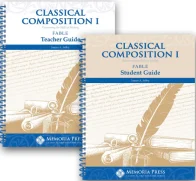
Classical Composition I: Fable Set (DVDs)
Has Fable Student Guide, Fable Teacher Guide and Fable Instructional Videos (DVDs).
$92.6513% off list $106.90 - Set
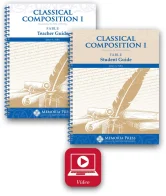
Classical Composition I: Fable Set (Streaming)
Has Fable Student Guide, Fable Teacher Guide and Fable Instructional Videos (Streaming).
$96.229% off list $106.90
Or buy the books one by one
- $18.9513% off list $21.95
- $25.9513% off list $29.95

Optional · not needed to finish the level
- $47.7513% off list $55.00
- $55.00
About this level: The first stage of the progymnasmata: students retell a fable, restructuring the facts and saying the same idea with different words and sentence structures. Memoria Press starts it in fourth grade; older beginners can take Fable and Narrative in one year.
Ready for more? II: Narrative (grades 5–7) comes next.
Grades 5–7II: Narrative
Students keep building invention and tell a story. Memoria Press places it in fifth grade, after Fable.2 sets · $90.65–$96.22
Choose one set
- Set
Classical Composition II: Narrative Set (DVDs)
Has Narrative Student Guide, Narrative Teacher Guide and Narrative Instructional Videos (DVDs) 2E.
$90.6515% off list $106.90 - Set
Classical Composition II: Narrative Set (Streaming)
Has Narrative Student Guide, Narrative Teacher Guide and Narrative Instructional Videos (Streaming).
$96.229% off list $106.90
Or buy the books one by one
- $18.9513% off list $21.95
- $25.9513% off list $29.95

Optional · not needed to finish the level
- $47.7513% off list $55.00
- $55.00

About this level: Students keep building invention and tell a story. Memoria Press places it in fifth grade, after Fable.
Need to start earlier? I: Fable (grades 4–6) comes before. Ready for more? III: Chreia & Maxim (grades 6–8) comes next.
Grades 6–8III: Chreia & Maxim
The Chreia and Maxim exercises, the third stage; Memoria Press places it in sixth grade.Set $96.22
Buy it as a set
- Set
Classical Composition III: Chreia & Maxim Set 2E (Streaming)
Has Chreia & Maxim Student 2E, Chreia & Maxim Teacher 2E and Chreia/Maxim Instructional Videos (Streaming) 2E.
$96.229% off list $106.90
Or buy the books one by one
- $18.9513% off list $21.95
- $25.9513% off list $29.95
Optional · not needed to finish the level
- $55.00
About this level: The Chreia and Maxim exercises, the third stage; Memoria Press places it in sixth grade.
Need to start earlier? II: Narrative (grades 5–7) comes before. Ready for more? IV: Refutation & Confirmation (grades 7–9) comes next.
Grades 7–9IV: Refutation & Confirmation
Two sets of exercises that work like an argumentative essay: students learn to structure an argument for or against an idea, a chain of events or a story. Memoria Press places it in seventh grade.2 sets · $83.65–$90.90
Choose one set
- Set
Classical Composition IV: Refutation & Confirmation Set (DVDs)
Has Refutation & Confirmation Student Guide, Refutation & Confirmation Teacher Guide and Refutation & Confirmation Instructional Videos (DVDs).
$83.6521% off list $106.90 - Set
Classical Composition IV: Refutation & Confirmation Set (Streaming)
Has Refutation & Confirmation Student Guide, Refutation & Confirmation Teacher Guide and Refutation & Confirmation Instructional Videos (Streaming).
$90.9014% off list $106.90
Or buy the books one by one
- $18.9513% off list $21.95
- $18.9513% off list $21.95
Optional · not needed to finish the level
- $47.7513% off list $55.00
- $55.00
About this level: Two sets of exercises that work like an argumentative essay: students learn to structure an argument for or against an idea, a chain of events or a story. Memoria Press places it in seventh grade.
Need to start earlier? III: Chreia & Maxim (grades 6–8) comes before. Ready for more? V: Common Topic (grades 8–10) comes next.
Grades 8–10V: Common Topic
The Common Topic stage, taken after stages I to IV; Memoria Press places it in eighth grade.2 sets · $90.65 each
Choose one set
- Set
Classical Composition V: Common Topic Set (DVDs)
Has Common Topic Student Guide, Common Topic Teacher Guide 2E and Common Topic Instructional Videos (DVDs).
$90.6515% off list $106.90 - Set
Classical Composition V: Common Topic Set (Streaming)
Has Common Topic Student Guide, Common Topic Teacher Guide 2E and Common Topic Instructional Videos (Streaming).
$90.6515% off list $106.90
Or buy the books one by one
- $18.9513% off list $21.95
- $25.9513% off list $29.95
Optional · not needed to finish the level
- $47.7513% off list $55.00
- $47.7513% off list $55.00

About this level: The Common Topic stage, taken after stages I to IV; Memoria Press places it in eighth grade.
Need to start earlier? IV: Refutation & Confirmation (grades 7–9) comes before. Ready for more? VI: Encomium, Invective & Comparison (grades 9–11) comes next.
Grades 9–11VI: Encomium, Invective & Comparison
Encomium, Invective and Comparison, taken after stages I to V; Memoria Press places it in ninth grade.2 sets · $90.65–$96.22
Choose one set
- Set
Classical Composition VI: Encomium, Invective, & Comparison Set (Streaming)
Has Encomium, Invective, & Comparison Student 2E, Encomium, Invective, & Comparison Teacher 2E and Encomium, Invective, & Comparison Instructional Videos (Streaming).
$96.229% off list $106.90 - Set
Classical Composition VI: Encomium, Invective, & Comparison Set (DVDs)
Has Encomium, Invective, & Comparison Student 2E, Encomium, Invective, & Comparison Teacher 2E and Encomium, Invective, & Comparison Instructional Videos (DVDs).
$90.6515% off list $106.90
Or buy the books one by one
- $18.9513% off list $21.95
- $25.9513% off list $29.95
Optional · not needed to finish the level
- $55.00
- $47.7513% off list $55.00
About this level: Encomium, Invective and Comparison, taken after stages I to V; Memoria Press places it in ninth grade.
Need to start earlier? V: Common Topic (grades 8–10) comes before. Ready for more? VII: Characterization (grades 10–12) comes next.
Grades 10–12VII: Characterization
Characterization, taken after stages I to VI; Memoria Press pairs it with Description in tenth grade.2 sets · $87.22–$87.90
Choose one set
- Set
Classical Composition VII: Characterization Set (Streaming)
Has Characterization Student, Characterization Teacher and Characterization Instructional Videos (Streaming).
$87.229% off list $96.90 - Set
Classical Composition VII: Characterization Set (DVDs)
Has Characterization Student, Characterization Teacher and Characterization Instructional Videos (DVDs).
$87.909% off list $96.90
Or buy the books one by one
- $18.9513% off list $21.95
- $25.9513% off list $29.95
Optional · not needed to finish the level
- $45.00
- $38.2515% off list $45.00
About this level: Characterization, taken after stages I to VI; Memoria Press pairs it with Description in tenth grade.
Need to start earlier? VI: Encomium, Invective & Comparison (grades 9–11) comes before. Ready for more? VIII: Description (grades 10–12) comes next.
Grades 10–12VIII: Description
Description, the companion stage to Characterization in Memoria Press's tenth grade.2 sets · $80.90–$87.22
Choose one set
- Set
Classical Composition VIII: Description Set (Streaming)
Has Description Student, Description Teacher and Description Instructional Videos (Streaming).
$87.229% off list $96.90 - Set
Classical Composition VIII: Description Set (DVDs)
Has Description Student, Description Teacher and Description Instructional Videos (DVDs).
$80.9016% off list $96.90
Or buy the books one by one
- $18.9513% off list $21.95
- $18.9534% off list $29.05
Optional · not needed to finish the level
- $45.00
- $38.2515% off list $45.00
About this level: Description, the companion stage to Characterization in Memoria Press's tenth grade.
Need to start earlier? VII: Characterization (grades 10–12) comes before. Ready for more? IX: Thesis & Law (grades 11–12) comes next.
Grades 11–12IX: Thesis & Law
The final stages bring in counterpoint and resolution. Students create arguments and defend them.Set $40.41
Buy it as a set
- Set
Classical Composition IX: Thesis & Law Set 2E
Has Thesis & Law Student Guide 2E and Thesis & Law Teacher Guide 2E.
$40.4122% off list $51.90
Or buy the books one by one
- $18.9513% off list $21.95
- $25.9513% off list $29.95
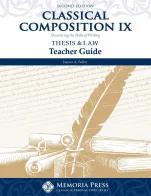
About this level: The final stages bring in counterpoint and resolution. Students create arguments and defend them.
Need to start earlier? VIII: Description (grades 10–12) comes before.
About Classical Composition
Classical Composition brings the progymnasmata, the graded exercises Quintilian and Cicero used to train speakers and writers, into a Memoria Press writing course. Jim Selby sets them out in nine stages, ordered from the simplest to the most demanding. A student starts by retelling a fable with fresh words and sentence structures, learns to argue for and against an idea, and finishes with thesis and law. There students create and defend arguments ready for rhetoric. Memoria Press points to Milton, Shakespeare and Benjamin Franklin as writers formed by this training. The stages run from fourth grade through high school, and older beginners can complete the first two in a single year.
Who it fits
- Worldview
- Religious
- Approach
- Classical
- Learning style
- Visual, Auditory
- Parent involvement
- Parent-led